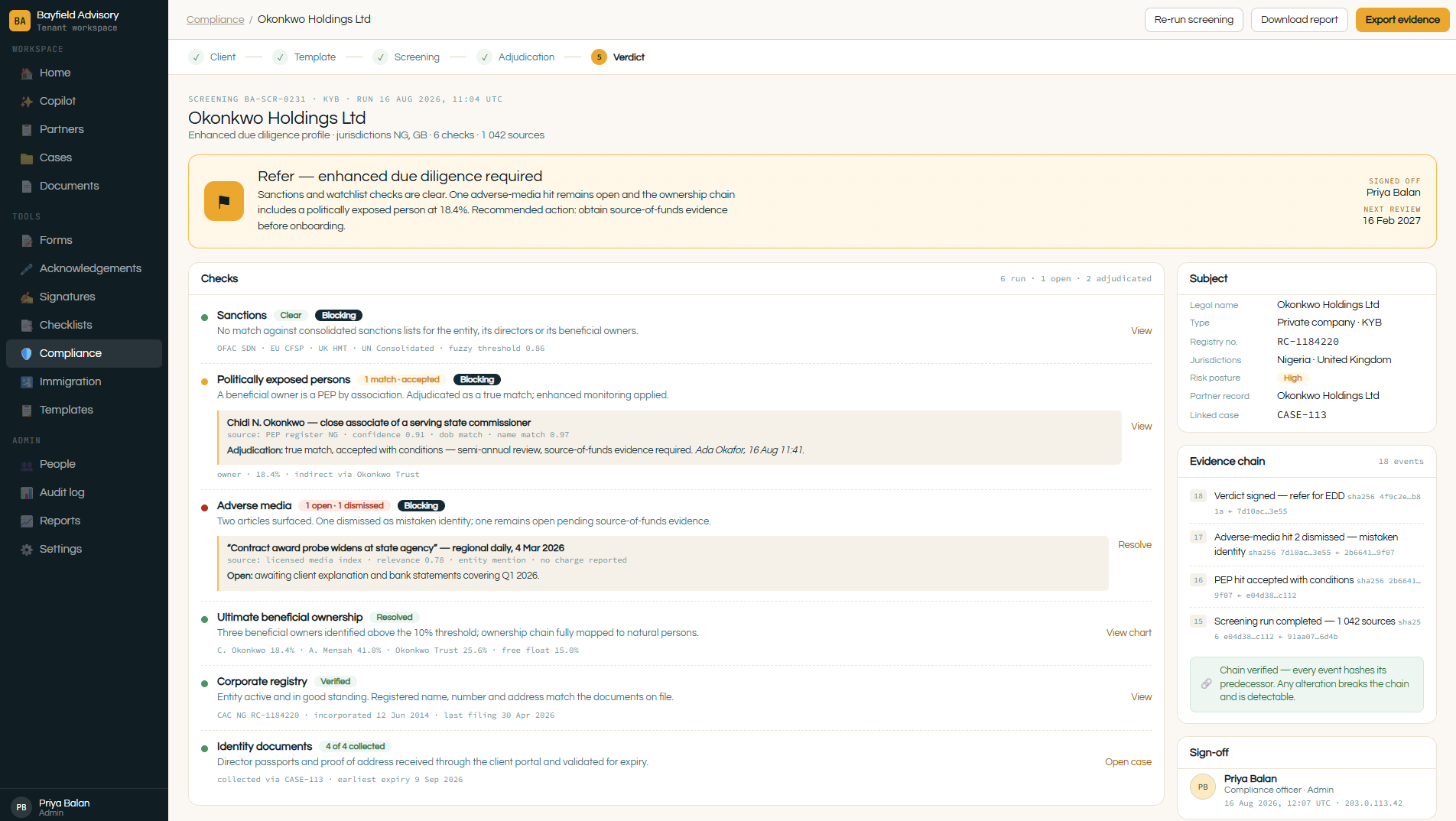
Check groups you switch on and off per service line
Live source adapters behind the AML, registry and media checks
Checks that report a pass they cannot evidence
A cleared file is only worth what you can prove about it later.
The vendor PDF nobody can re-open. The shareholder who held 40 percent through two holding companies. The clean result you cannot show the workings for, after the analyst who signed it has left.
Paper Vault records the question it asked, the answer it got, and the hash that proves neither changed.
Compliance review
One client, one file, one decision — sitting beside every other case your firm runs, not in a separate tool.
Screening template
Which checks run, who owns each, and what your policy says when a source cannot answer. Draft, publish, version.
Screening
One run, snapshotting the programme as it starts. Revising the template later changes nothing you already signed.
One button starts it. Your client never learns the word “screening”.
Launch
One wizard opens the case, grants portal access, and emails an invite.
The client collects
A checklist and a form in the portal. No account to configure.
The gate holds
Screening stays locked until the files are in. Sequencing, not a reminder.
The run
One AI pass reads every document; the AML checks dispatch live.
Adjudicate and sign
A position on every check, then one verdict and one signature.
Monitoring
Re-screens on cadence and opens a task when something changes.
Lookup is evidence, not a guess
An ambiguous email shows you the candidates and asks. A shared domain never attaches a partner on its own.
One link, three password modes
Set, skip, or verify — resolved when the link is opened, so the sender never needs to know which applies.
Two windows, kept separate
How long a link opens the case, and how long it skips the password, are different settings. Shared mailboxes make that matter.
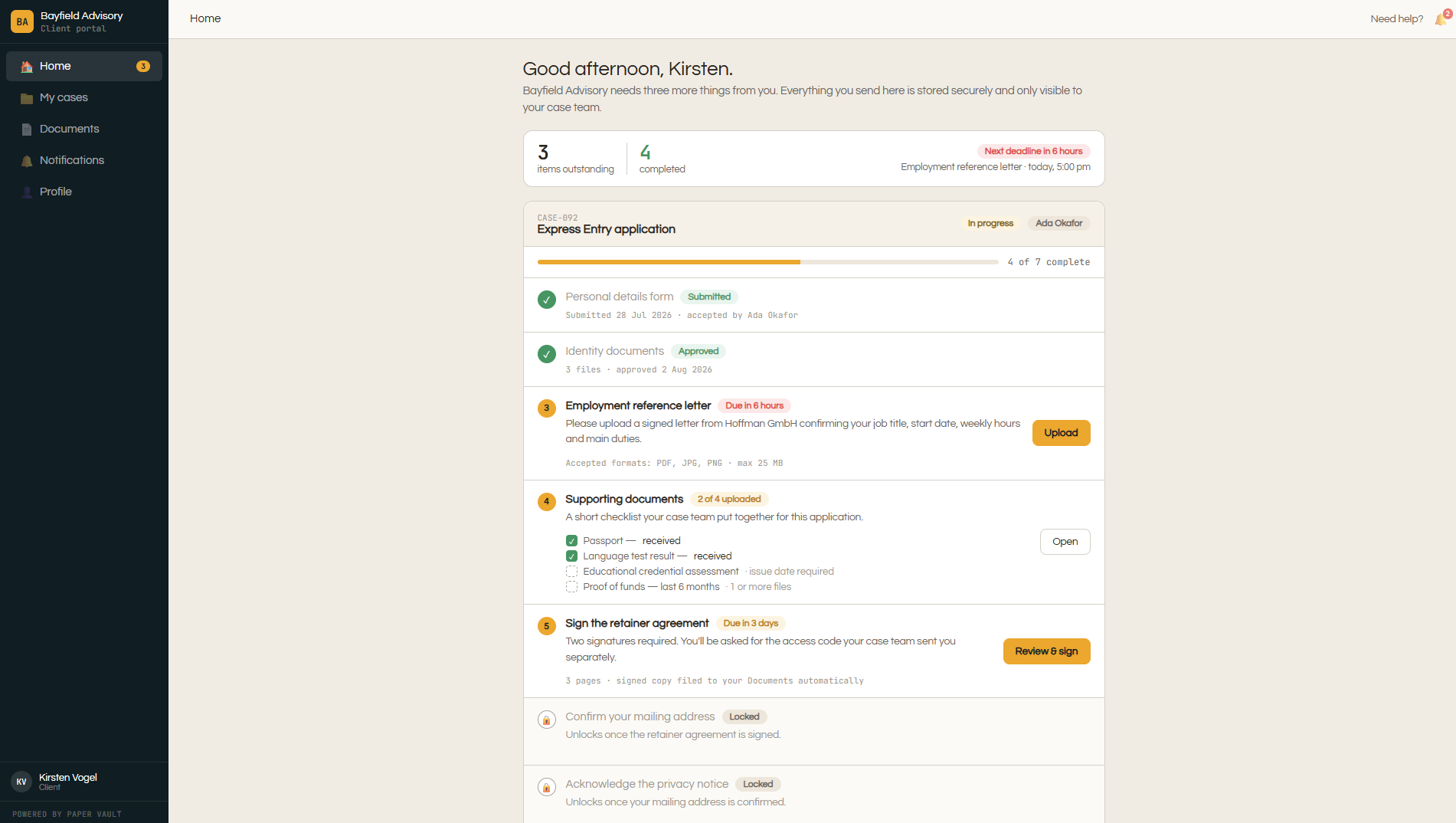
Eight steps, and two of them come before any query goes out
Before you ask an outside source about a client, you read what the client sent. That is why the first two steps exist.
Data review
OpenThe intake exactly as submitted, annotated with what the AI validation flagged.
Documents review
OpenApprove or reject each file. A rejection re-opens that item in the client’s portal.
Client
One entity requiredSubject entities, AI-extracted or added by hand, and the ownership tree.
Template
Read-onlyThe checks this screening runs, with owners and blocking flags.
Screening
Locked until documents and intake are inThe run, with a live progress overlay. Sources snapshot as it starts.
Review and report
Where the AI suggestions surfaceA position on every check, a ruling on every hit, and the scoring report.
Additional information
Optional — locks the verdict, except declineAI builds a form for what would clear each finding, sends it, and re-runs on approval.
Verdict
Locked while any check is unconfirmedOne decision, one rationale, one signature. The report generates and attaches.
Every Continue says why it is locked — “three still unconfirmed, sign-off stays locked” — rather than showing a dead button.
Seven AI surfaces. Not one of them decides anything.
Extraction is the AI’s job. Adjudication is not.
Vision reads the machine-readable zone; code computes the checksum. Where verification is deterministic, a check passes on its own. Where it is a judgement about authenticity, the AI produces a triage signal that routes to an analyst — never a clear.
The review agent
Advisory onlyIt reads the whole case file, searches your knowledge base, and proposes a result per check with citations. Three rules bound it:
Your own knowledge base
AML policy, typologies, jurisdiction rules and your own written procedures, retrieved and cited. Each check also carries a rubric, so the model is never asked to invent your risk appetite.
Retrieval is scoped to your tenant. One firm’s knowledge never informs another’s.
URL ingestion is guarded: HTTPS only, IP literals refused, size and time caps, and a managed domain allowlist.
46 checks in nine groups. You choose which ones run.
Declare the service, the subject and the diligence level, and the programme pre-selects itself. Every selection stays yours to change.
First match wins — and the last branch is an honest refusal
A specialised resolver
Deterministic code over extracted facts: checksums, date windows, bill totals, registry reconciliation. These can pass on their own.
A live source
The AML and registry checks dispatch to their adapters and classify each hit by the topics it carries.
Nothing can answer it
It returns for review, says why in plain words, and — if blocking — correctly holds your sign-off.
Verified by something deterministic, and the finding says what.
A real adverse signal, with the candidate records attached.
An honest “this needs a person”, never a pass by omission.
That is the machine signal. Your analyst’s own position is a separate record and always theirs.
All ten AML checks, all wired
Hits are classified by the topics an entity carries, not by which list they came from — so a sanctioned politically exposed person flags sanctions and PEP. One lookup, not ten.
Who really owns this, once you multiply it out
The AI proposes the tree; your analyst curates it. Six checks then read it — proportional multiplication, the 50 percent aggregation, control persons, and the fallback when no natural person resolves.
A layer recorded at zero percent that still has owners beneath it is surfaced as a gap in the disclosure, not dressed up as a result.
With no curated tree, all six fall through honestly. The tree locks at sign-off and joins the legal record.
Four mechanisms sit between the raw results and the decision.
Weighted risk scoring
Geography, customer, ownership, channel and screening outcomes — your weights, your bands. Stamped so a signed report stays reproducible.
Due-diligence tiering
Simplified, standard or enhanced. The upgrade is automatic and one-way; a downgrade needs its own permission and records who used it.
Consistency crosschecks
Name, identifier, date of birth, address and incorporation date reconciled across every source you hold. Each disagreement is ruled match, mismatch or explained.
Decision hard stops
Five conditions remove a clean approval, each with a suggested filing reason. Re-checked on the server when the verdict is emitted.
What a hard stop takes away
It removes only the clean approve. The analyst is never trapped — and disabling the button is a courtesy, not the enforcement.
Sign-off, separate from the verdict
Your template says which roles are required — analyst, MLRO, second approver. One live signature per role: a re-sign revokes the previous one and keeps both in the history.
The report
Twenty-four sections, in-app and as a Unicode-safe PDF. Copied onto the record at sign-off, so it says today what it said the day it was signed.
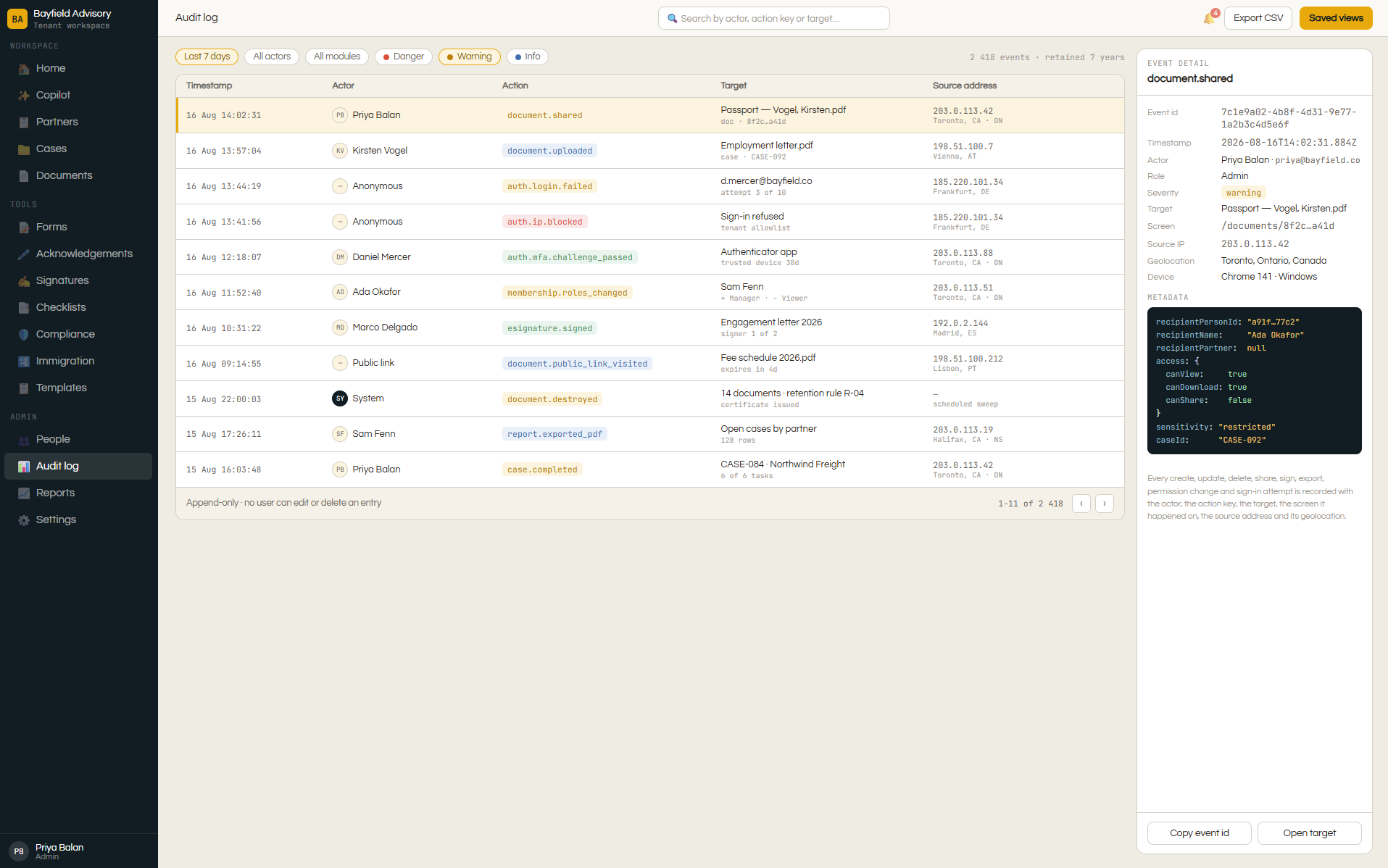
Every external query is recorded in an append-only hash chain.
The request that went out and the response that came back, each row carrying the hash of the one before it.
Verify
Recomputes every hash in order and surfaces the first inconsistent row — where and what changed, not merely that something did.
Export
The full log with verification metadata embedded, as one self-contained file a regulator can still open in five years.
Capture
Freezes the treasury and sanctions pages a hit cites as PDFs. Host-allowlisted: anything else is recorded blocked and never requested.
Roughly sixty compliance actions are audited, every AI call among them. Evidence reads deliberately are not — high volume, no signal. Bulk export is, because extracting a compliance log is itself a compliance event.
A verdict is a moment. A programme is a subscription.
The remediation loop
Mark what you cannot clear, and the AI builds a form asking for exactly what would clear it. The screening re-runs by itself on approval.
The verdict locks while a round is out — except decline. No firm should be forced to hold an application open for an answer it no longer needs.
Suspicious activity filings
Reason, regulator, narrative, status, and a snapshot of the triggers as they stood at filing. References are yours and citable — SAR-2026-0007.
Kept off the client surface by law, not by preference — the rule against tipping off. Two independent layers enforce it.
Thirteen separate permissions, from reading a screening to filing a report. Every entry point is tenant-only three times over — a portal-flagged permission, a defensive refusal, and row-level scoping. How security and tenancy work.
Priced on the depth of diligence, not on seats.
Attaches to any paid Paper Vault tier. Your whole team is included on all three.
Screening
Clear a name properly, with the evidence to show for it.
Diligence
Most firmsUnwind the ownership, score the risk, get a cited second opinion.
Programme
Run a whole AML programme — monitored, documented, grounded in your procedures.
On Demand
Pay per reviewEvery Screening and Diligence feature, with nothing to commit to — for firms whose reviews arrive in bursts rather than every month.
Continuous monitoring, the SAR register and your own knowledge base stay with Programme.
CAD, plus HST, on top of your Paper Vault subscription. One expert module is included at Enterprise. See the full rate card.
Run it on a real client file this week.
Launch one review, watch the client fill their own checklist, and read the report it produces.